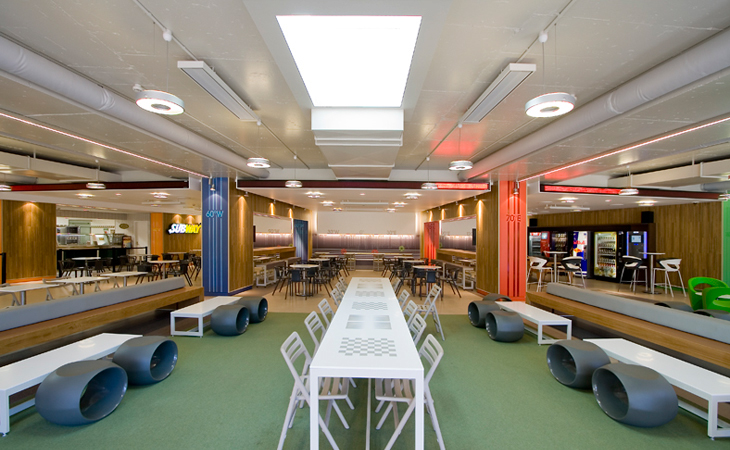
This project explores student experiences with campus food courts and cafes at the University of Wollongong (UOW), focusing on satisfaction across four key areas: (1) enjoyment, (2) convenience, (3) sociability, and (4) comfort. The project aims to reveal whether these communal dining spaces effectively support students’ academic and social lives by offering welcoming, functional, and inclusive environments.
The guiding research question is: Are students satisfied with campus food courts and cafes? To answer this question, primary data will be collected to assess student sentiments regarding the food quality, variety, nutrition, affordability, and how well these offerings align with student needs. Attention will also be given to dietary diversity and cultural inclusivity.
Beyond campus food offerings, the research will examine the physical and environmental aspects of these spaces, such as seating, lighting, noise levels, and layout, to evaluate how they impact student comfort, productivity, and opportunities for social interaction. The influence of location and accessibility will also be considered, mainly whether distance from key academic buildings affects student engagement with on-campus dining.
As an extension to my primary research efforts, secondary research has effectively informed my research topic as well. A journal article by Bryan Gentry from the University of South Carolina suggests that campus food courts function to promote community and reduce political disagreements and political ‘polarisation’ between students. (Gentry, 2023) His findings suggest that sharing meals in a communal space builds student trust and assists with the ability to challenge and dismantle stereotypes and prejudices, which, in effect, enhances the quality of classroom discourse and group productivity. (Gentry, 2023)
By extension, John Boswell from Northern Illinois University presents the idea that dining on campus elevates student success beyond factors regarding nutrition. (Boswell, 2023) The nature of a shared dining space assists in the development of inclusivity, belonging and the promotion of social interaction, all vital aspects to a student’s academic engagement and psychological wellbeing. (Boswell, 2023)
Beyond a student’s mental wellbeing is a student’s physical comfort regarding their sentiments toward the architectural design and physical arrangements of the dining spaces they use. Arda Akyildiz from the Firat University Architectural Faculty suggests that seating arrangements and design elements increase a person’s chances of spending more than an hour within a communal dining space. (Akyildiz, 2019) Findings suggest that design elements such as noise control, comfortable seating, natural lighting, and sound ‘spatial flow’ function to increase wellbeing and comfort, making people more likely to utilise the facility for longer than the time it takes to consume a single meal. (Akyildiz, 2019)
By investigating these factors, the project seeks to generate insights that can inform improvements to the student dining experience at UOW. Findings could potentially guide upgrades to food options, pricing models, space design, and location planning. In relation to primary research, methods will include an online survey with targeted questions to capture student habits, preferences, and satisfaction levels. Topics will cover the frequency of visits, food quality and value, space usability, and general impressions. To complement survey data, small group interviews with BCM212 students will allow for more in-depth reflections and narratives, providing qualitative context to the broader trends.
This mixed-methods approach ensures both breadth and depth in understanding how students engage with campus dining spaces. The combination of quantitative and qualitative data will strengthen the project’s conclusions and support evidence-based recommendations. The research is incredibly timely, given rising cost-of-living pressures and the growing emphasis on student wellbeing post-COVID. As universities aim to provide holistic, inclusive student experiences, the quality of campus food and dining spaces plays a critical role. The topic is highly relevant and achievable due to the accessibility of the student population and the simplicity of the data collection methods, which can be completed within a single semester.
With regard to my sentiments toward the topic, as a regular user of UOW’s dining facilities, I’ve often found them lacking in diverse, healthy options and comfortable seating arrangements. Overcrowding, long lines, and poor spatial layouts frequently disrupt the dining experience. These frustrations sparked my interest in researching whether others share similar views and how these spaces might be improved to serve the student body better.
Academic Reference List:
Arda-Akyildiz, N. and Polat, H. (2019). Social Interaction Organizations Of Consumption Habits; Cafeterias. [online] ResearchGate. Available at: https://www.researchgate.net/publication/347485471_Social_Interaction_Organizations_Of_Consuption_Habits_Cafeterias [Accessed 19 Mar. 2025].
Boswell, J. (2023). The Relationship Between Campus Dining, Student Learning, and The Relationship Between Campus Dining, Student Learning, and Student Success Student Success. [online] Available at: https://huskiecommons.lib.niu.edu/cgi/viewcontent.cgi?article=8127&context=allgraduate-thesesdissertations.
Gentry, B. (2025). The Dining Hall Could Help Save Democracy — Heterodox Academy. [online] Heterodox Academy. Available at: The Dining Hall Could Help Save Democracy — Heterodox Academy [Accessed 11 Mar. 2025].
Naiara Martinez-Perez, Liv Elin Torheim, Nerea Castro-Díaz and Arroyo-Izaga, M. (2021). On-campus food environment, purchase behaviours, preferences and opinions in a Norwegian university community. Public Health Nutrition, [online] 25(6), pp.1619–1630.
doi:https://doi.org/10.1017/s136898002100272x.
Neely, E., Walton, M. and Stephens, C. (2014). Young people’s food practices and social relationships. A thematic synthesis. Appetite, [online] 82, pp.50–60. doi:https://doi.org/10.1016/j.appet.2014.07.005.
 Nicholas Steven
Leave a comment